
People often imagine that experienced collectors possess an instinct that new collectors lack. They seem to enter a gallery already knowing which artists carry significance, which visual languages resonate with them, and which works merit closer attention. That instinct is built through exposure to art.
Traditionally, that exposure has come through years of visiting museums and galleries, studying art history, and encountering unfamiliar work. These experiences are valuable, and they require time, access, and a certain degree of privilege. A new collector does not need to spend years preparing before feeling entitled to begin. There is a more immediate path: collecting itself.
Taste develops differently when art enters your home. Looking at a painting in a gallery for several minutes may introduce you to it; living with it allows a far deeper relationship to unfold. You encounter it in the morning, under shifting afternoon light, while moving through the room, and through periods of happiness, uncertainty, growth, and loss. Over time, the work becomes part of the emotional and visual architecture of your life.
This kind of immersion teaches you what no amount of detached observation can. You begin to notice which colors continue to hold your attention, which subjects remain emotionally resonant, and which works reveal greater complexity over time. You learn what you love, rather than what you believe you are supposed to admire.
The work becomes a presence: familiar, intimate, never completely exhausted. You may have seen it hundreds of times, and a gesture, an expression, a passage of color can still reach you differently. Collecting is one of the most powerful ways taste is formed.
Where is the right place to start?
Anywhere. A new collector may begin without knowing the difference between Surrealism and Abstraction, or between Expressionism and Figurative Art. That is completely fine. You do not need an art history degree to recognize when something speaks to you.
Perhaps your first attraction is to hyperrealistic painting, because you are captivated by technical mastery: the precision of a hand, the rendering of fabric, the illusion of light moving across skin.

Kelvin Jumanne's The Inheritance is that kind of encounter. He spent more than 250 hours in charcoal and oil pastel on a mother braiding her daughter's hair, keeping the figures in black and white while the Ankara fabric and the daughter's red dress hold their color. Heritage passes from one hand to another, strand by strand.
Years later, you may find yourself drawn to abstraction, where emotion is conveyed through color, gesture, rhythm, and material rather than recognizable imagery.
One preference is no more sophisticated than the other. Nor is the movement from realism to abstraction a necessary progression. Some collectors remain devoted to figurative work throughout their lives. Others build collections that move freely among realism, abstraction, photography, sculpture, and conceptual art. Taste does not develop along a single, orderly path. It shifts, expands, doubles back, and occasionally surprises the person developing it.
What matters is that your choices are sincere. You may collect a work because it reminds you of a particular place, because its color transforms the atmosphere of a room, because it gives form to an emotion you have never been able to articulate, or because you believe in an artist and want to accompany the evolution of a career. There is no single respectable reason to love a work of art. The sincerity of the response is reason enough.
Do you know why you love it?
"Buy what you love" is probably the most common advice given to new collectors. It is good advice, and it is incomplete. Love can be immediate, and immediacy is not always depth. Our response to an artwork can be intensified by the atmosphere of a gallery, the presenter's confidence, the artist's reputation, or the fear that someone else may acquire it first. The more revealing question is whether the attraction survives once those influences disappear.
Does the work remain in your mind after you have left the gallery? Do you feel compelled to return to it? Does learning more about the artist deepen your response, or was the story more compelling than the work itself? Does it continue to reveal something after the first impression has passed?
You do not need to interrogate every feeling until the pleasure disappears. Collecting should keep its instinct and its exhilaration of discovery. Refining taste simply asks for greater attentiveness to the nature of your own attraction.
Would I still want this work if no one else admired it?
Am I responding to the artwork itself, or to the status, urgency, and language surrounding it?
What does this work allow me to feel, notice, or understand that I could not access as clearly before?
Does it satisfy my existing taste, or does it expand it?
Can I imagine encountering this work years from now, through changes in my home, my circumstances, and myself?
These questions help you distinguish between a passing desire and a work that can become part of your life. The more honestly you understand why you are drawn to something, the more confidently you can collect without surrendering your judgment to outside approval.
What does an artwork give you first?
Art is often discussed as an investment, and that conversation matters. Collectors naturally want to understand an artist's career, pricing, exhibition history, market position, and lasting potential. The first return an artwork gives you, though, is the experience of living with it. A meaningful work changes the character of a room, and it can change the way you think. It may offer calm, provoke questions, preserve a memory, or remind you of a part of yourself that daily life tends to bury beneath schedules and obligations.
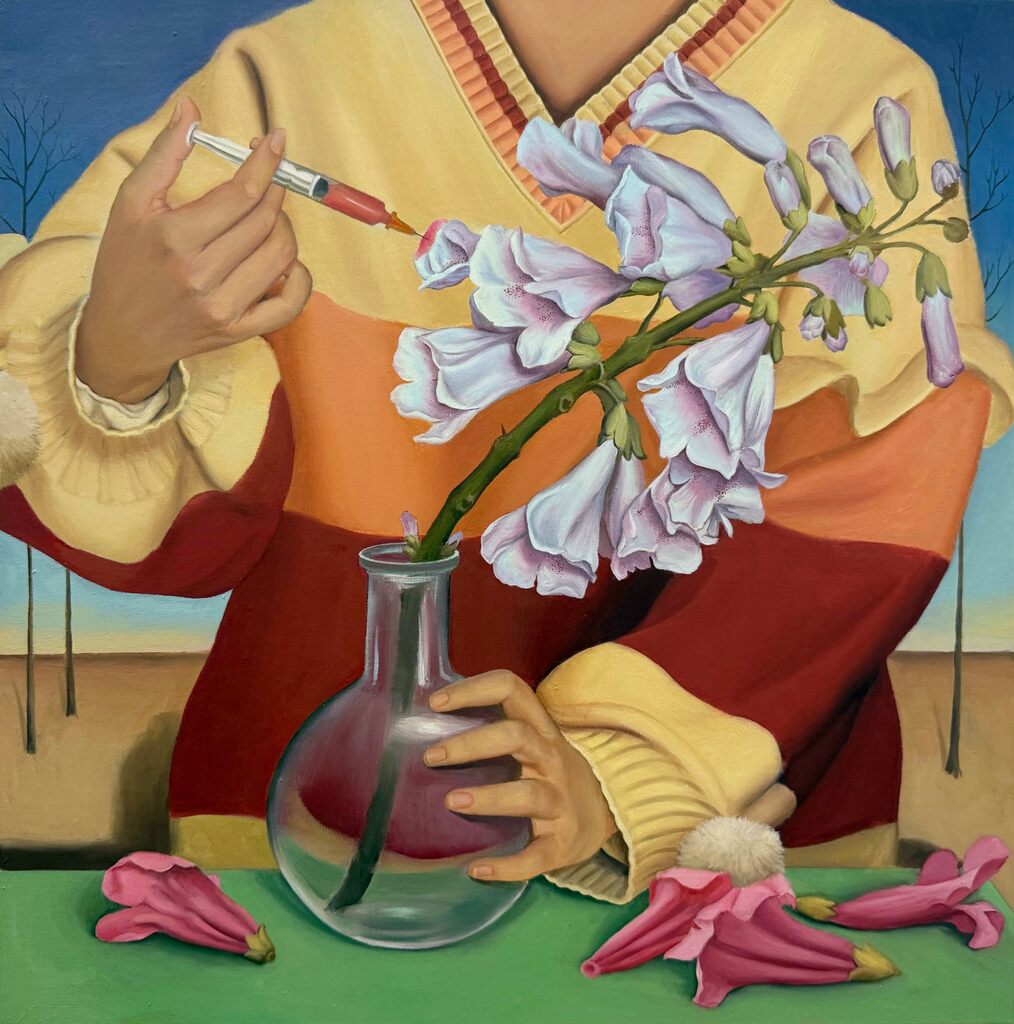
Tianhao's Parenting is such a work. The entire painting asks one question: is this nurturing, or manipulation? A collector can live with that question for years and never wear it out. Every visitor who stops in front of it will answer differently, and the conversation it starts in a home is worth more than any wall it hangs on.
That is already a form of value. An artwork may appreciate financially, and future value should never be the only measure of a meaningful acquisition. What can be evaluated in the present is the artist's seriousness, the quality and consistency of the practice, the evolution of the work, and the commitment behind the career. The strongest acquisitions possess value before any future resale is considered. They enrich the present.
"Once a meaningful artwork has occupied your wall, your home no longer feels the same without it."
Kate SamWhat do we look for at KB Fine Art?
An artwork must first command attention. Technical skill, compositional intelligence, material sensitivity, and visual presence form the foundation of everything we consider. Just as exceptional food is the basic expectation of a serious restaurant, compelling execution is the minimum expectation of a serious gallery.
Visual appeal alone is never enough. We look for depth: an idea, a tension, a question, an emotional necessity that extends beyond the visible surface. What is the artist investigating? Why did this image need to exist? Does the work emerge from a searching artistic inquiry, or does it merely answer a passing visual trend? We are interested in artworks that continue to unfold after their immediate impact has been absorbed. Our role is to recognize that depth and help collectors encounter it.
What begins when a painting sells?
Our approach to collecting is relational. Art creates relationships: between the artist and the collector, the artwork and the home, the gallery and the people who trust us to guide them. For us, the sale of a painting begins a longer conversation. We want to understand what collectors respond to, what they already live with, and what ideas, emotions, or visual experiences they hope to bring into their homes.
Our hope is that both our collectors and our artists will lead remarkable lives enriched by the artworks we have had the privilege to represent. To know that these works have become part of their homes, their memories, and their experience of the world would be among our greatest sources of pride.
When will you be ready?
There is no official moment when someone becomes knowledgeable enough to own art. You can study for years and still feel uncertain; the more seriously you engage with art, the more aware you become of its vastness. Developing taste means becoming more comfortable with careful looking and allowing your understanding to change.
Your first acquisition only needs to begin a relationship. Start with the work that remains in your thoughts. Live with it. Watch how it changes in morning light and through different periods of your own life. Notice what continues to hold your attention and what the work gradually teaches you about your values. Then look again.
Taste grows through museums, galleries, research, conversations, and repeated encounters. Its most intimate education occurs at home, where an artwork gradually stops feeling like something you purchased and becomes inseparable from the life unfolding around it. That experience is difficult to understand from the outside. Sometimes you have to place the art on the wall and allow the relationship to begin.