Haotian 郝恬 Who gets to decide what home looks like?
Haotian paints rooms filled with colour, art and the possibility of a different life. In conversation with KB FINE ART, she reflects on what it means to make a home of her own.
Haotian 郝恬 paints homes where she would want to live: a chair beside a window, flowers on a table, a view that reaches beyond the room. Growing up, she often felt afraid at home. Painting gives her a way to imagine what she needed there: comfort, freedom and space to be herself.
In a conversation with KB FINE ART, Haotian described how her parents dismissed her feelings and questioned what she saw and heard. She learned to hide what she wanted, including how much she loved painting. For years, she treated other people’s criticism as proof that something was wrong with her.
Today, Haotian works in Wuhan, China, and returns to the home throughout her paintings. She describes these imagined places as a source of emotional support. Her rooms give her control over decisions she once struggled to make for herself, from what surrounds her to how she wants to spend her time.
That connection helps explain why she gives so much attention to an empty chair or a place to read. She is imagining the everyday experience of feeling at ease at home.
Learning to trust herself
Before she began postgraduate study, Haotian feared that her English would stop her from getting in. She studied intensively and passed the required English examination. But she had applied to the wrong programme and sat a specialist examination in ethnology instead of painting. She had to try again.
When she retook the entrance examinations, she passed English with a slightly higher score. Her family had often explained her successes as luck. Passing twice gave her evidence she could trust: she had worked hard, and her work had helped her improve.
During postgraduate study, she began taking her own interest in painting seriously. She studied materials and worked between theory and practice. She also met people whose responses to her differed from those she had grown up hearing. She describes this as finding more mirrors. Her parents’ judgment no longer supplied her only picture of herself.
Look at A Room Made of Choices. A black chair faces a grey scene containing a lone figure, footprints and a bare tree. Red walls and blue panels surround that scene. The contrast draws attention to two different spaces: the bleak view in front of the chair and the colourful room around it.
Haotian has not described this painting as an illustration of her childhood. Still, her experience offers a way to understand its arrangement. From the chair, someone can look at the grey scene without standing inside it. The painting gives distance a physical form: a room, a seat and a place from which to look. Knowing her struggle to trust herself makes that separation especially affecting.


A home where she can rest
Haotian values the calm of her relationship with her partner. She describes an ordinary life together, without the pressure and control she knew growing up. That ordinariness helped her build a life beyond her parents’ expectations.
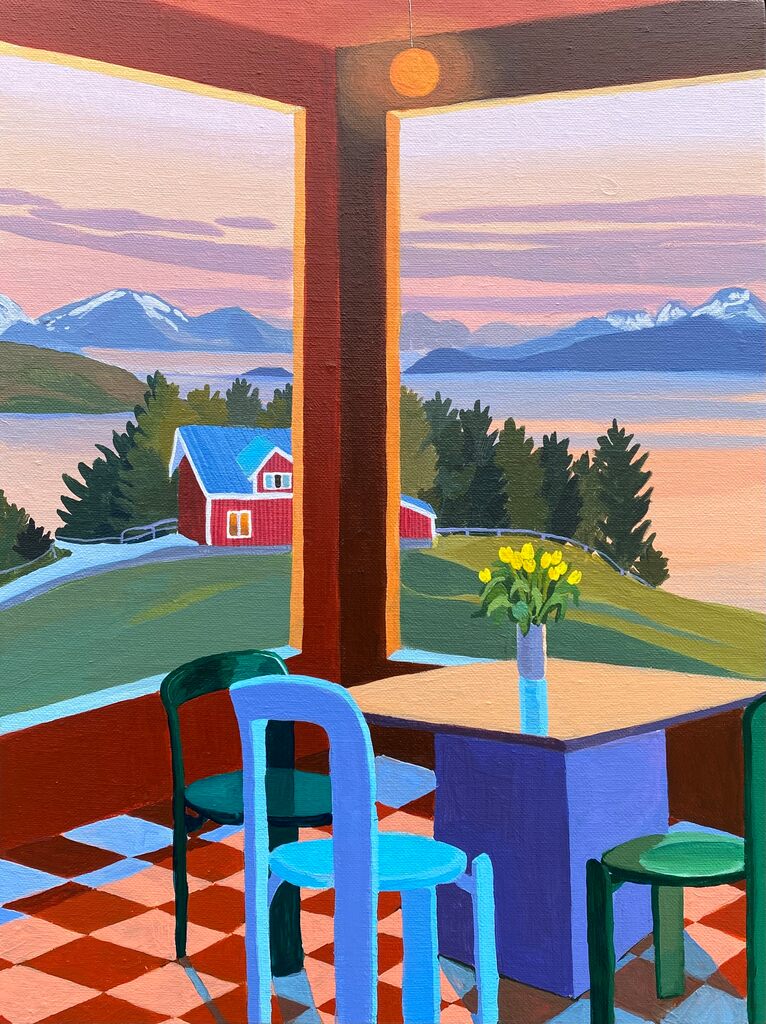
In Our Nordic Home, she gathers chairs around a table with flowers at its centre. Water, mountains and a red house fill the view beyond the windows. The table gives people a reason to sit together; the landscape gives them somewhere to let their attention wander. You can imagine an afternoon here without anyone needing to arrange an occasion.
The Card Players suggests company through the cards on the table, although no players appear. Those objects let us imagine the people ourselves. We might picture friends who have just stepped away or a game about to begin. Haotian leaves enough of the evening unfinished for our own memories to enter.
In Dreamscape, a woman reclines with a yellow book over her face. She has stopped reading. Pale roof beams frame the blue sky, and a meadow and pond stretch beyond her resting place. The book makes the moment recognisable: she picked it up to do something, then allowed herself to stop.
Haotian has not identified the woman as herself. But the scene gains emotional depth when we remember how she once hid her interests and tried to satisfy other people’s expectations. Here, nobody watches the woman or asks her to be useful. Haotian gives rest an entire painting.
How colour opens up a room
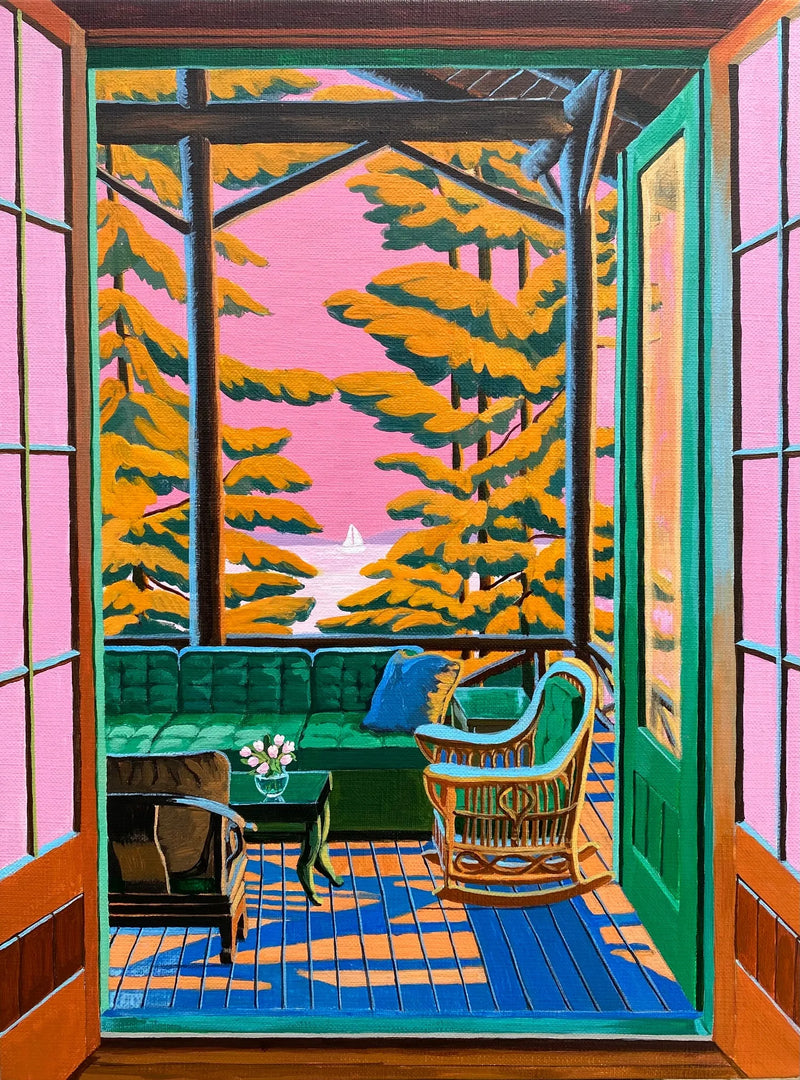
In Hockney’s Lakehouse, open green doors frame a furnished balcony. Blue floorboards and orange bands of light lead towards a sofa, a wicker chair and golden trees. Through the branches, a small white sailboat marks the distance.
Follow the green through the picture. It moves from the doors to the furniture and into the foliage, joining the room to the landscape. Then look at the pink sky against the golden trees. Haotian uses colour to connect the parts of the view while making the whole place feel unlike anything we could simply photograph.
The door frames and dark beams give the scene a firm structure. Without them, the bright colours could pull our attention in too many directions. We can enjoy the pink sky because the architecture tells us where we stand. Haotian combines the pleasure of an unfamiliar view with the reassurance of a room we can understand.
She develops this relationship between shelter and distance in The Warmest Room in Norway, where curved seating and glowing lamps face cold water and snowy mountains. In Back at Oxfordshire, a glazed door opens towards fields. In each painting, the outside view helps us appreciate the particular comfort of the space inside.
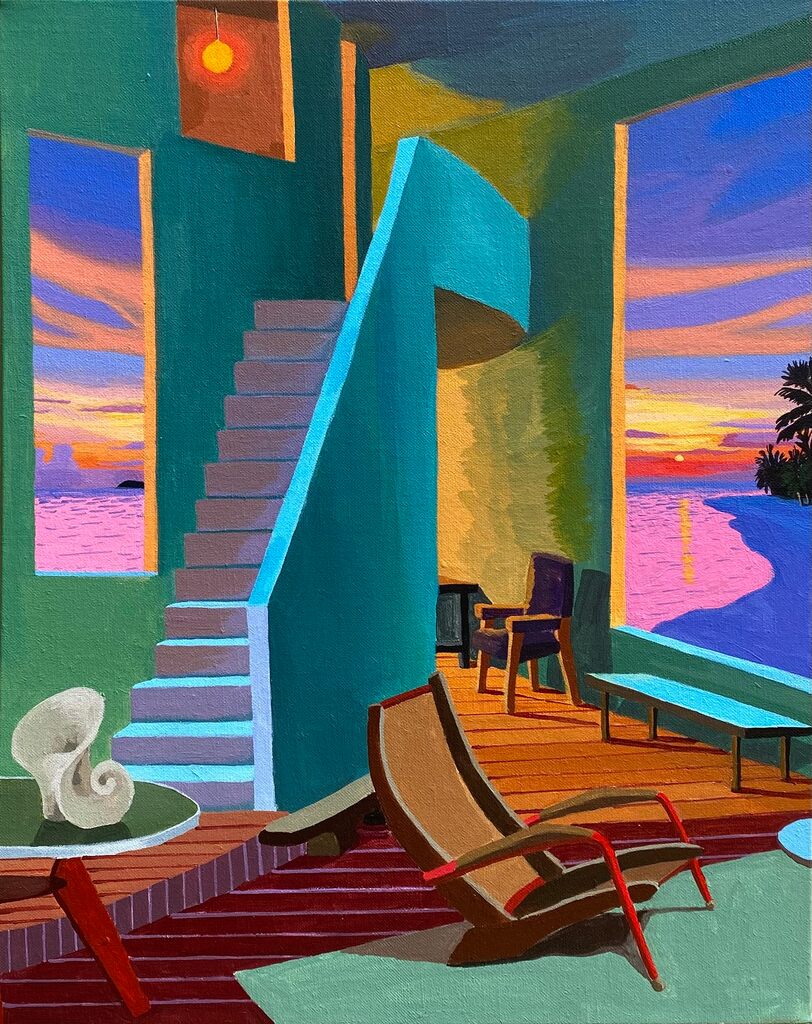
Costa Careyes introduces a more complicated interior. A staircase divides the room, while separate openings reveal the sunset. Our eyes have several routes to follow. Haotian says that painting more complex subjects has made her more absorbed in her work. These rooms let her test how many views, objects and colours she can bring together without losing the sense of a place.
Flowers inside and outside
Haotian’s gardens help explain her interiors. In Elysium and The Scent of Spring, trees, paths and flowering plants guide our eyes through the landscape. Leaves interrupt the view, so we discover the scene a little at a time.
In the interiors, she brings that growth indoors through fabric and decoration. The flower-patterned sofa in Golden Hour sits before an extensive landscape. In Leseraum, botanical patterns surround a window seat, with books below and mountains beyond. The garden becomes something we could sit on or lean against, as well as something we see through a window.
Her colours do not always create comfort. The Fractured Eden packs dark trunks, hanging strands and dense leaves against hot pink, turquoise and orange. The overlapping forms obstruct our view. Compare that density with the clear doorway in Hockney’s Lakehouse: one painting makes us search for a way through; the other provides it. Bright colour can create tension as readily as pleasure in Haotian’s work.

Making room for art
Haotian also imagines how people live with paintings. In Picasso’s Bedroom, she places an art reference above a bed where an animal rests. In In Hockney’s Corner, a reading chair sits among bookshelves and floral wallpaper. These rooms bring art into the routines of sleeping, reading and spending time at home.
For a collector, that is a familiar relationship. A painting becomes part of the room where you drink coffee, pass an afternoon or sit with someone you love. Haotian paints those surroundings too. Furniture, books and flowers show how a work of art can belong to a lived space.
Painting has given Haotian a place to express feelings she once kept hidden. She describes returning to it during difficult periods and gradually finding it easier to connect with other people again. She also speaks with enthusiasm about learning, experimenting with materials and discovering what she can do with a more demanding composition.
Both experiences shape how we can look at her work. The inviting rooms come from someone who knows that home does not automatically feel safe. Their careful construction comes from an artist who wants to keep improving. In Dreamscape, she gives someone permission to rest. In Our Nordic Home, she makes space for company. In Hockney’s Lakehouse, she gives us shelter without closing off the view. Each painting makes the idea of a more generous home specific enough to imagine living there.