
Tianhao is a visual philosopher. Beneath the enigmatic beauty of his paintings lies a searching investigation into the human condition: freedom, identity, fear, desire, morality, and the unseen psychological forces that govern our behavior. Familiar objects, animals, interiors, and landscapes are removed from ordinary logic and transformed into symbols, inviting viewers into deeper intellectual and emotional terrain.
What is a philosopher? Someone who refuses to take ordinary life for granted, who stops at the questions the rest of us hurry past: why we live the way we do, what we owe the people who love us, what a life is for. A visual philosopher does that same work in images instead of sentences. Where a writer builds an argument out of propositions, Tianhao builds one out of light, objects, and space: a horse, a grandfather clock, a giraffe, a vessel of glass become the terms of an inquiry. Each canvas poses a question so precisely that the viewer cannot help beginning to answer it.
His philosophy is his own, formed by watching closely how people actually live. Are we guided by our authentic desires, or by structures we have learned to accept? Does safety protect us, or confine us? What remains when the people and beliefs we depend on can no longer offer direction? These are his questions, and he asks them in paint.
No series demonstrates this more completely than the one he names after the inquiry itself. The Human Condition unfolds across five paintings, and each takes one of those abstract questions and gives it a body, a room, a light source. Watch the method at work.
What if comfort is the cage?
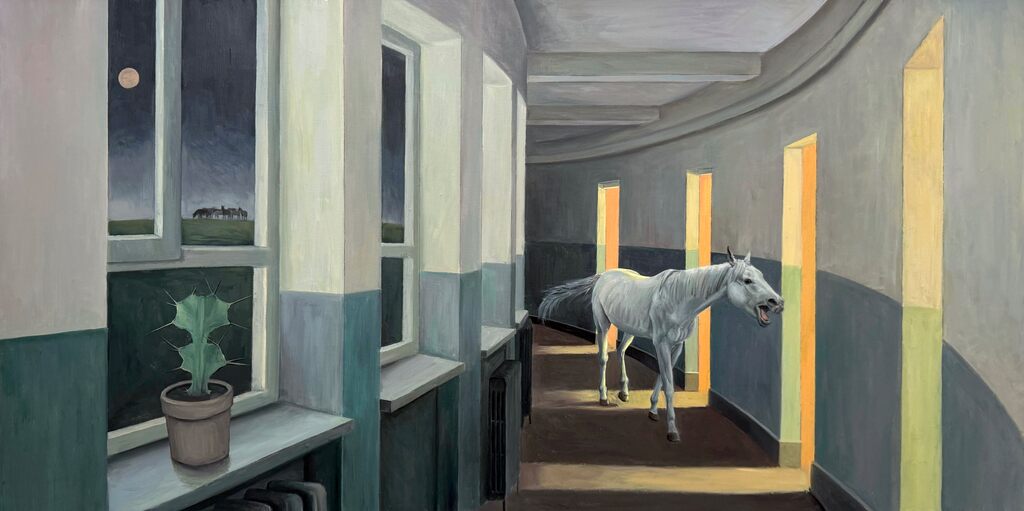
The painting at the head of this article opens the series. A horse that once ran open ground now wanders a curved corridor with no visible end, lined with identical doors, each glowing with warm light. Nothing bars the animal's way. That is precisely the problem. The corridor is comfortable, and comfort has done what no fence could: it has dulled the instinct to leave. On the floor sits a potted cactus, a creature that survives by needing almost nothing, an emblem of endurance through submission. Through a single window, under a full moon, a herd runs free across open land. The horse stands between the doors and the field. It does not choose a door. It does not become the cactus. It does not reach the field. So it remains where it is, and the viewer is left holding the question the image was built to ask: how much of our own stillness is contentment, and how much is a habit of warm light? This is Tianhao's first proposition: what holds most of us in place is comfort, which can imprison more completely than any fence. He states it with one animal standing still in a hallway, and the image lands because most of us recognize the corridor. We live in one.
What if the light is at the bottom of the dark?
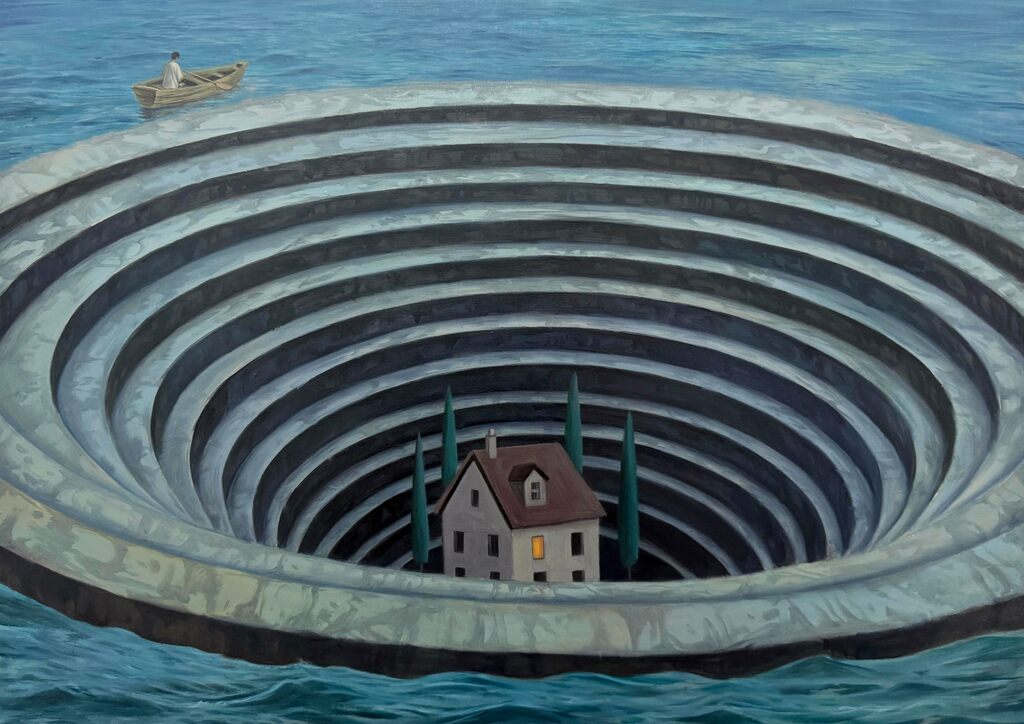
The second painting turns from confinement to descent. Everyone knows the sensation of being pulled downward by life: pressure, grief, exhaustion, a season when existence simply feels heavy. The spiral gives that invisible weight a physical form. It is emotional gravity made visible, the pull of depths one cannot easily resist. Then comes the surprise at the bottom: a house, warm and illuminated. This is the heart of Tianhao's philosophy of suffering. The deepest place within us is not purely tragic. A private interior world survives there, holding light and shelter even when everything around it feels vast, unstable, and consuming. The painting proposes something braver still: at our lowest point, some part of us may preserve light, seek refuge, and become a place of shelter for another. The fall is real. So is the house.
Who decided when her life is due?
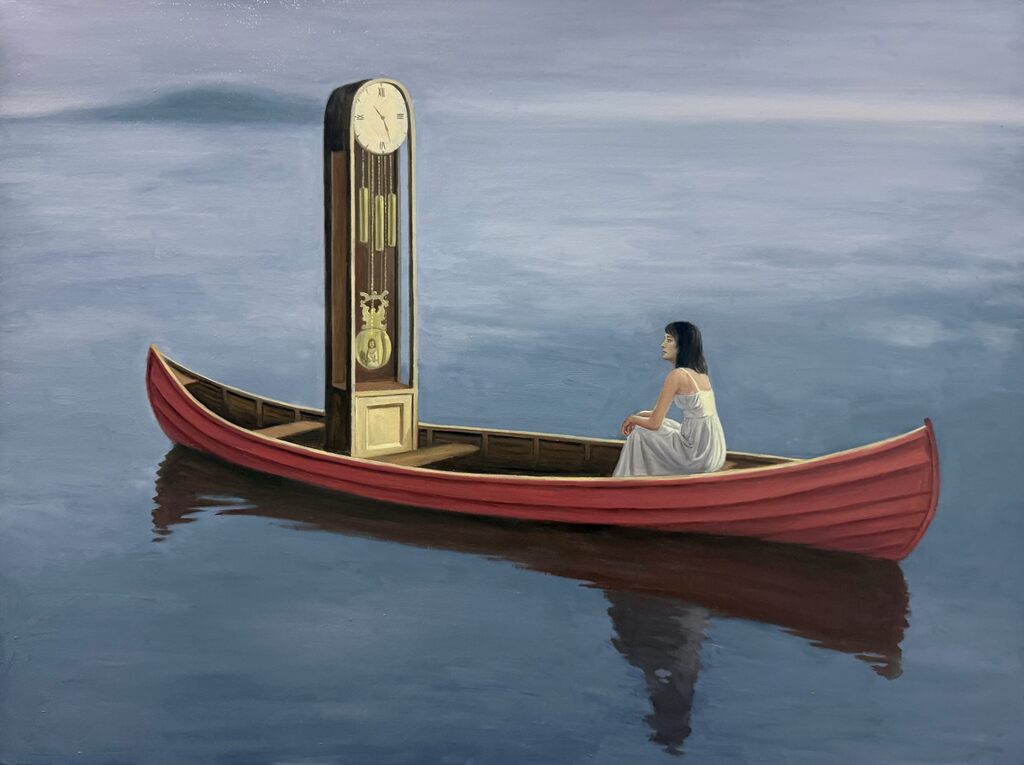
In the third work, a woman drifts alone in a red boat through fog. Upright beside her stands a grandfather clock: domestic order, family expectation, the timeline others insist on calling biological. The clock stands for the schedules a woman is handed: married by this age, a mother by that one, measured her whole life against a timeline someone else wrote. Tianhao's reply is one quiet decision. The water, which cannot lie, reflects the woman and the boat with perfect fidelity and refuses the clock. Her life holds no such schedule. She did not bring the clock aboard; it was the weight she was taught to carry.
This sensitivity was shaped in part by the loss of his mother at an early age, an experience that profoundly altered his understanding of vulnerability and the instability of life. Rather than hardening him, loss appears to have deepened his capacity for empathy. It informs his concern for lives that are overlooked or rendered invisible, particularly the experiences of women in societies where their autonomy, labor, and suffering may go unrecognized.
Which self is living your life?
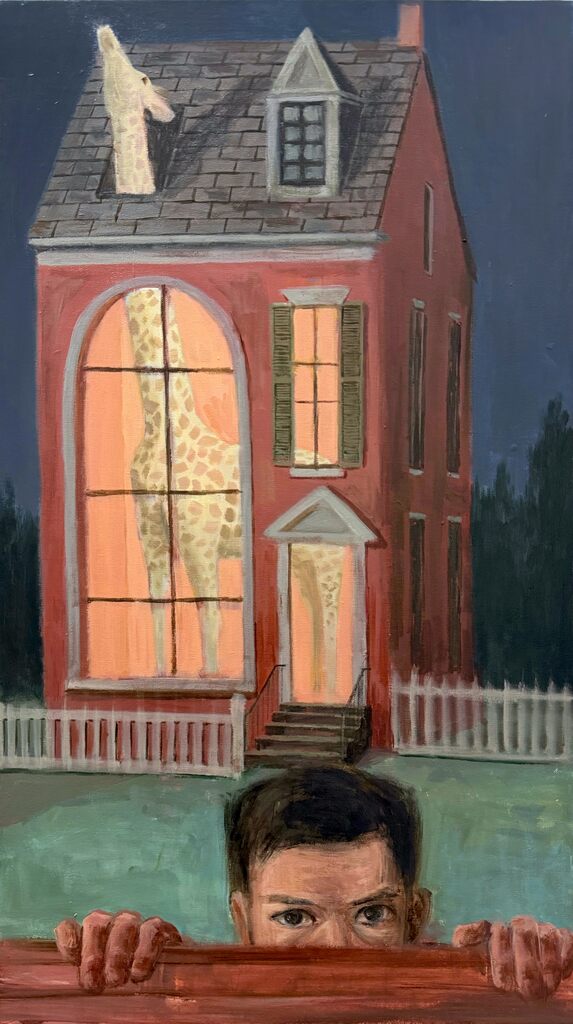
The fourth painting sets two figures inside a house too small for either of them. A giraffe stands compressed within the narrow rooms, its neck rising through the roof into the night air, while a man remains below in the warm interior. The glow makes captivity resemble sanctuary, which is how most captivity survives. Tianhao sees every person carrying two selves: one shaped to fit its circumstances, and a larger one those circumstances were never built to hold. The painting turns that belief into a building. The man fits the house; the giraffe never could. And he paints the hope into the structure itself, for the roof is already open and the neck is already out in the night air. Freedom begins the moment the self that can imagine another life and the self willing to pursue it move as one.
Do we love people, or what they give us?
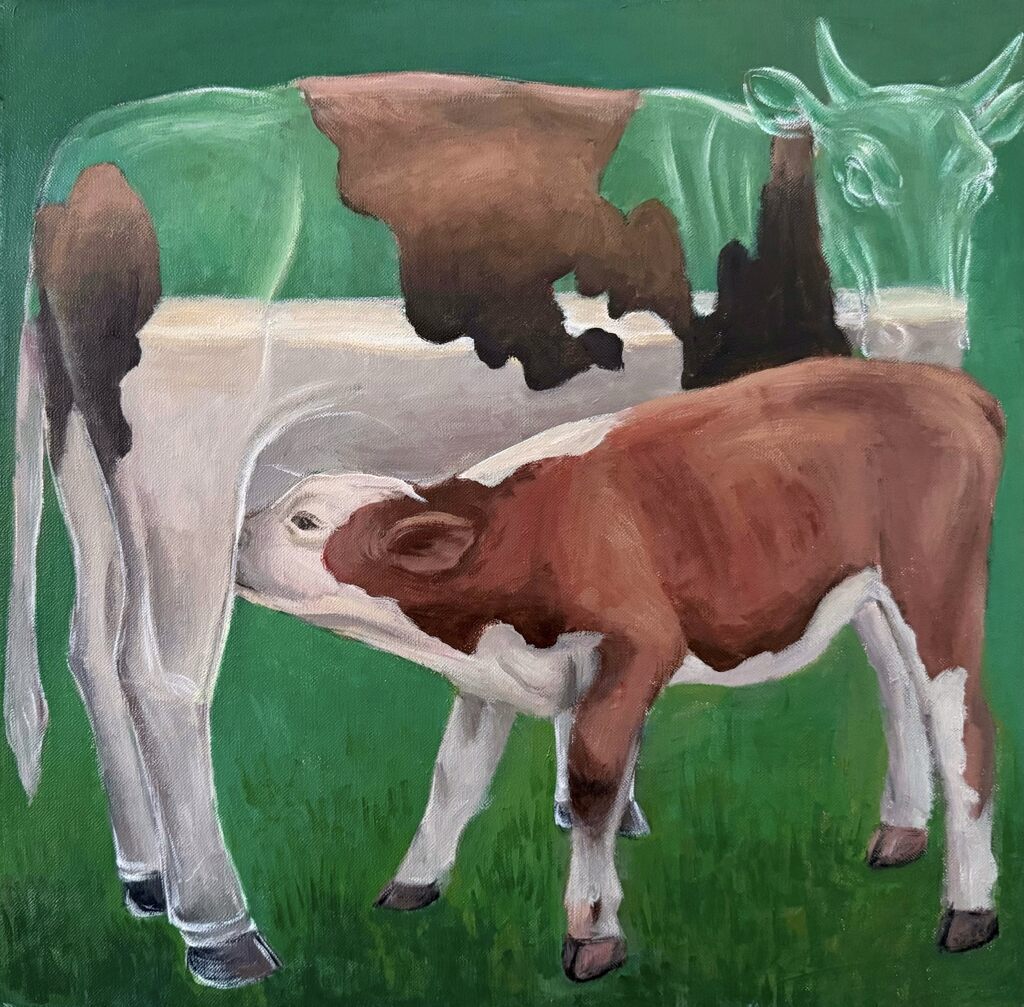
The series closes with its most unsettling image. A mother cow has become a vessel of glass, her body a transparent container storing milk, while a calf drinks, trusting completely, from a shell that holds no warmth. Here Tianhao states his hardest conviction: no person should be reduced to a function, because every person is a whole world of her own. The painting shows that conviction failing inside the closest bond we have. He chooses glass for a devastating reason: we can see straight through the mother to the function she has been reduced to, while the calf mistakes dependence for intimacy. Do we ever encounter the people who sustain us as complete beings, or only as the roles they perform for our benefit?
Look back across the five paintings and the definition offered at the start of this article stops being abstract. Each work begins with an ordinary thing: a horse, a house, a clock, a giraffe, a mother. Each finds the question that thing carries: why we stay where we are unhappy, how meaning survives at the bottom of a life, who wrote the schedules we live by, why we feel like two people in one body, what happens to those who are only ever needed. Then each turns the question back into the thing itself, so the idea can be inhabited on sight. All five ask; none concludes. That is what it means to call Tianhao a visual philosopher.
"He notices what others might pass without seeing, allowing even the smallest object to carry the weight of memory, fear, tenderness, or social critique."
Kate SamHis imagination begins with close attention to the physical world. Stones, shells, insects, changing weather, plants, animals, and fragments of domestic life all enter his visual vocabulary. These modest elements are then placed within expansive psychological and philosophical narratives, where a single object can hold an entire argument.
A metaphysical presence can also be felt throughout much of Tianhao's work. Light, distance, silence, and the vastness of nature often suggest forces beyond the visible world. His paintings do not prescribe a particular faith; they frequently carry a sense of spiritual authorship, as though the image has arrived through him rather than solely from him.
The Human Condition is one line of questioning within a practice that already spans several series, each pursuing its own inquiry. One article cannot hold them all, and it does not need to. There will be more to say.
Tianhao is at a significant stage in his development. His growing body of work demonstrates rare philosophical depth, technical commitment, and an increasingly distinct visual language. Our focus is on supporting a thoughtful and sustainable artistic trajectory. For collectors, this is an important moment to encounter his work: early enough to witness an artist still expanding his language, and far enough into his practice to recognize the seriousness and lasting potential of his vision.