
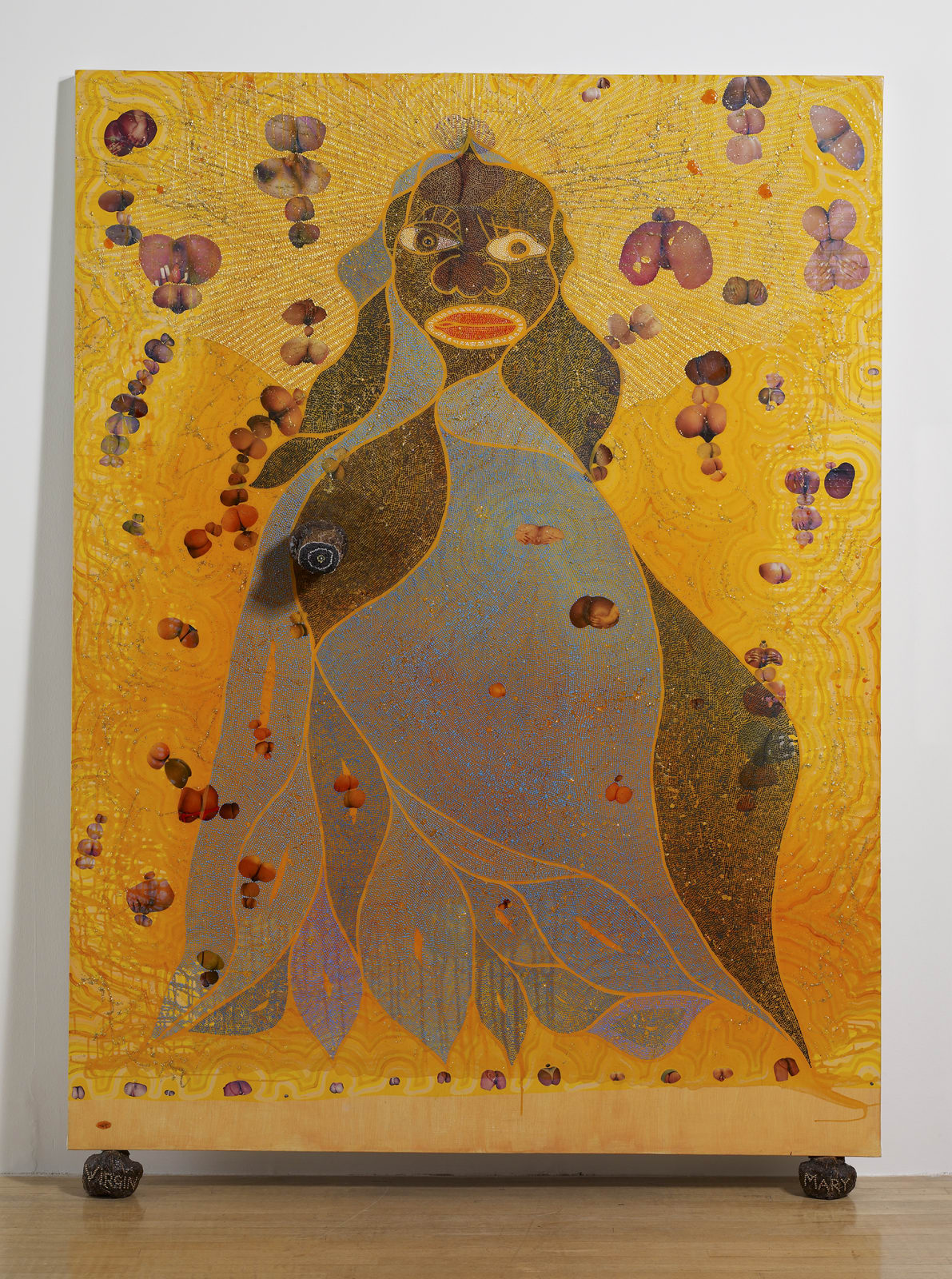

In 1999, Chris Ofili’s The Holy Virgin Mary became the center of a political confrontation over the Brooklyn Museum’s exhibition Sensation. New York mayor Rudolph Giuliani threatened to withdraw municipal funding, and the resulting controversy carried Ofili’s work far beyond the audience that would ordinarily encounter it in a museum or gallery.
The Art Basel and UBS Global Art Market Report 2026 uses the episode to show how abruptly media attention can enter an artist’s market. Two weeks after the controversy intensified, every work in Ofili’s solo exhibition Afrobiotics was reportedly sold. That December, Untitled fetched $136,500 at Christie’s in London—four times his previous auction record.
Ofili is not presented as an artist whose career subsequently failed. His later institutional standing makes the example more revealing, not less: publicity can accelerate price before the slower processes of criticism and art history have reached their own conclusions. Sometimes those judgments eventually support the market’s enthusiasm; sometimes they revise it.
The report calls the more precarious version of this trajectory the “rocket artist”—an artist whose prices rise meteorically through media attention, overexposure, insider excitement, and speculative buying, then risk falling just as quickly.
The label is arresting; the mechanism is not. What has changed is its speed.
What is a “rocket artist”?
A “rocket artist” is a living artist whose prices rise extremely quickly through publicity, market scarcity, and speculative demand before the artist’s critical and institutional reputation has had time to mature. If that attention moves elsewhere, prices can fall with equal speed.
In the report’s exact formulation, “after a meteoric rise, these artists may fall just as rapidly.” The sentence matters because it describes a risk, not a verdict. Sudden visibility does not guarantee collapse, just as a high auction price does not guarantee lasting significance.
Which examples does the 2026 Art Market Report give?
The report does not publish a list of artists it formally classifies as “rocket artists.” Instead, it uses several examples to separate the mechanisms through which visibility can enter a market.
Chris Ofili demonstrates controversy-driven acceleration. The uproar surrounding The Holy Virgin Mary carried his work into a national political argument; his solo exhibition reportedly sold out, and an auction result followed at four times his previous record. Ofili’s subsequent career also demonstrates why a rapid price increase is not sufficient evidence of a speculative failure: long-term institutional and critical judgment may confirm what publicity first accelerated.
James Turrell’s Aten Reign demonstrates a different mechanism. Turrell asked visitors not to photograph the 2013 Guggenheim installation, but images of its immersive color circulated widely on Instagram. The work became highly visible through the very behavior the artist had attempted to prevent. Here, the report’s subject is not an auction collapse but the growing independence of visibility from artistic intention.
Maurizio Cattelan’s Comedian provides the report’s clearest numerical example. One edition sold for $120,000 at Art Basel Miami Beach in 2019; another sold at Sotheby’s for $6.2 million in 2024—an increase of more than 5,000%. The report argues that the rise reflected the buyer’s willingness to pay for the work’s function as a “viral device,” rather than a proportional increase in Cattelan’s already substantial artistic recognition.
Taken together, the examples identify three accelerants: controversy, shareable spectacle, and a price that becomes news in itself. None proves that publicity is fraudulent or that the artist lacks merit. They show how attention can establish a market tempo that criticism, institutions, and the artist’s own development may not be able—or willing—to follow.
An artist’s market can acquire this trajectory when three systems begin reinforcing one another.
First, limited primary-market supply produces frustrated demand. Responsible galleries place works selectively, often favoring collectors and institutions likely to support an artist over time. When demand greatly exceeds supply, however, buyers who cannot obtain work from a gallery may turn to public auction, where access belongs to the highest bidder.
Second, an exceptional auction result becomes publicity for the next sale. A work estimated at one level sells for several times that amount; the result travels through headlines, social media, databases, and private conversations; price momentum begins to look like evidence of historical importance. The distinction between visibility and artistic value collapses.
Third, the public nature of auction encourages an asset-trading mentality. Buyers can see the result, compare it with earlier sales, and imagine an immediate future return. A long artistic practice is judged on a short financial clock.
The danger is not success. Artists need sales, galleries need revenue, and collectors are entitled to resell works they own. The danger begins when a single public price is treated as proof of a durable market before the artist’s critical, institutional, and collector base has had time to develop.
What happened to ultra-contemporary art after the boom?
The figures in The Art Basel and UBS Global Art Market Report 2026 show how sharply the newest sector of the auction market expanded—and how quickly it contracted.
Works made within 20 years of their sale accounted for 25% of the value of Postwar and Contemporary auctions in 2019. Their share reached 34% in 2021, aided by intense demand for recently created work and NFTs. In that peak year, 21 recently made works sold for more than $10 million.
The reversal began soon afterward. Sales of recently created works fell 43% between 2023 and 2024, leaving the segment at roughly one-third of its 2021 value. In 2025, its share of Postwar and Contemporary auction value fell again, to 19%, while sales declined another 18%. Only three recently created works sold for more than $10 million that year. (Download the complete 2026 Art Market Report.)
This was not a universal collapse. It was a reallocation. In 2024, total art-market value declined while transaction volume rose 3% to 40.5 million, driven by activity at more accessible price levels. Smaller dealers with annual turnover below $250,000 reported 17% growth. (Download The Art Basel and UBS Global Art Market Report 2025.) In 2025, global sales returned to modest growth and transaction volume rose again, to 41.5 million, even as the market for recently made work continued to contract.
The broad art market, in other words, did not disappear. The speculative premium attached to one part of it was corrected.
What does the correction cost a living artist?
A falling stock price can be described as a drawdown. For a living artist, the consequences are more personal and more difficult to reverse.
An inflated primary baseline
When a painting sells at auction for a spectacular sum, pressure grows to make primary prices reflect that public benchmark. If speculative demand then recedes, the gallery faces an impossible choice: maintain a price the market will no longer support, or reduce it and make the correction visible.
Secondary-market illiquidity
Auction houses manage risk as well as opportunity. Once demand weakens, they may decline further consignments, attach conservative estimates, or accept only the strongest examples. The artist can move rapidly from overexposure to an absence of public transactions.
A distorted critical reception
Curators and critics do not simply follow price, but premature commercial attention can overwhelm the work itself. The artist becomes known as a market phenomenon before the practice has been understood. Every subsequent exhibition is read as evidence for or against a valuation.
Pressure on the studio
Sudden demand rewards repetition. The market asks for more of the work it already recognizes, precisely when an artist may need time to experiment, discard, reconsider, and change. A short boom can therefore damage the very development on which a long career depends.
The rocket trajectory exchanges gradual recognition for immediate velocity. Its apparent efficiency is the trap.
What is a primary gallery built to do?
The Art Basel and UBS Global Art Market Report 2026 offers a useful description of the work that disappears when a gallery is understood merely as a sales intermediary. Galleries create what economic literature calls “small historical events”: a museum acquisition, a serious catalogue, an institutional exhibition, a curator’s studio visit, a carefully argued solo presentation. No single event establishes an artist’s place in history. Their accumulation can.
This changes how a responsible gallery approaches growth.
Placement before price maximization
At auction, price allocates the work. In the primary market, a gallery can consider where the work will live, whether the collector has a history of rapid resale, whether the work may be lent to exhibitions, and whether the placement strengthens the artist’s development. The objective is not to prevent a secondary market forever. It is to prevent a premature one from defining the career.
A rhythm that permits development
An artist should not be required to manufacture a constant stream of recognizable inventory for fairs and annual shows. Exhibitions need enough distance between them for the practice to acquire depth. The correct interval varies by artist, but the principle is constant: production should follow the work, not the publicity cycle.
Cross-subsidizing discovery
Gallery economics are highly concentrated. According to the 2026 Art Market Report, dealers received one-third of sales from their highest-selling artist in 2025 and 58% from their top three. Among primary-market dealers, the concentration was still greater: 35% from the leading artist and 60% from the top three. For the smallest galleries, the top three generated 65% of sales.
That concentration is a vulnerability, but it also explains how a program functions. Revenue from commercially established artists can support exhibitions, publications, promotion, production, and the time required to develop artists who are not yet profitable. Primary-only galleries reported devoting 6% of operating expenditure to supporting artwork production, framing, and related activities. (See the dealer-sector analysis in the 2026 report.)
Artist-direct sales are not inherently harmful, and artists have legitimate reasons to retain autonomy. But the economic context matters. Among the high-net-worth collectors surveyed, the share of spending allocated to artist-direct purchases doubled from 10% in 2021 to 20% in 2025. When a gallery has invested in building demand and the resulting sale bypasses it, the effect reaches beyond one commission: it reduces the resources available to sustain the wider program.
How can an artist and gallery manage two clocks?
An artist and gallery must operate with two clocks in view.
The first is the market clock: immediate, measurable, and impatient. It records waiting lists, auction results, social reach, press attention, and sales from the current exhibition.
The second is the career clock: slow, cumulative, and difficult to measure. It records the development of the work, the quality of collections, critical writing, institutional engagement, and the artist’s capacity to remain intellectually alive across decades.
A durable strategy does not ignore the market clock. It refuses to let that clock govern every decision.
Years 1–5: incubation
- Establish prices that reflect the work’s scale, production, and career stage—not speculative demand.
- Place important works with collectors willing to lend, exhibit, and hold them.
- Support production without compelling the artist to repeat a successful formula.
- Begin the historical record through thoughtful exhibitions, documentation, and serious critical writing.
Years 5–15: consolidation
- Raise prices gradually and in relation to genuine, sustained demand.
- Allow meaningful intervals between solo exhibitions.
- Develop museum relationships, publications, and curatorial dialogue.
- Monitor auction activity and intervene through collector communication before resale becomes a pattern.
Years 15–30 and beyond: endurance
- Build a secondary market supported by depth rather than scarcity alone.
- Preserve archives and establish rigorous provenance and documentation.
- Prepare for retrospectives, scholarly study, and—eventually—estate stewardship.
- Continue allowing the work to change. Longevity without artistic development is merely duration.
What is happening beneath the auction headlines?
The most useful lesson in the recent reports is not that the art market is dying. It is that a market can contract at the top while remaining active, even expanding, elsewhere.
In 2025, works priced below $50,000 accounted for 95% of fine-art auction transactions. Primary galleries reached gender parity in the artists they represented on average, while works by female artists rose to 44% of primary-gallery sales by value. Smaller dealers recorded the strongest increase in transaction volume, up 15%. (Read or download the official 2026 report.)
These figures do not justify easy optimism. Costs are high, attention is fragmented, and many galleries and artists remain financially exposed. They do show that the market visible in trophy-auction headlines is not the whole market.
The deflation of a speculative bubble can create room for a more exacting kind of attention. Collectors can look beyond the auction record and ask how the work has developed, who has written about it, where it has been exhibited, and what it might mean to live with it for years rather than trade it within months.
That is not a retreat from the market. It is a return to the part of the market capable of sustaining art.
Questions collectors ask about “rocket artists”
Does one auction result establish an artist’s value?
No. An auction result records what particular bidders were willing to pay for one work at one moment. A durable market requires repeated transactions, consistent primary-market demand, serious collections, critical attention, and institutional support.
Why can rapid resale hurt a living artist?
Repeated resale can push public prices beyond sustainable primary prices, encourage studios to repeat commercially successful work, and make an artist’s practice appear driven by speculation rather than development. A secondary market is not inherently harmful; timing, supply, and price stability matter.
What should collectors examine beyond auction prices?
Look at the development of the work across several years, the quality and independence of critical writing, museum and institutional engagement, exhibition history, provenance, and the gallery’s approach to placement and pricing. Price is evidence of demand, not a substitute for judgment.
Where can readers download the Art Basel and UBS Art Market Reports?
The official reports are linked below. Each title leads directly to the corresponding PDF published by Art Basel or its official document host.
Art Basel and UBS Art Market Reports, 2022–2026
- Download The Art Market 2022: An Art Basel & UBS Report.
- Download The Art Basel and UBS Art Market Report 2023.
- Download The Art Basel and UBS Art Market Report 2024.
- Download The Art Basel and UBS Global Art Market Report 2025.
- Download The Art Basel and UBS Global Art Market Report 2026.
Continue exploring
- Read “What Pace Gallery Reveals About the Future of the Art World.”
- Discover the artists presented by KB Fine Art.
- Explore available artworks.
This article is editorial analysis by KB Fine Art. It interprets published market research from the perspective of a primary gallery; it is not investment advice.